Over the years, millions of parents and teachers have come to trust Jane Nelsens classic Positive Discipline series for its consistent, commonsense approach to childrearing. Now, the bestselling series addresses the specific challenges that parents and teachers of children with special needs face, and offers them straightforward advice for supporting them in positive ways. In these pages are practical solutions to challenges such as:
Dr. Jane Nelsen is a California licensed Marriage and Family Therapist and author or co-author of 18 books, including
Positive Discipline, Raising Self-Reliant Children in a Self-Indulgent World, Serenity, When Your Dog is Like Family, and 12 other books in the
Positive Discipline Series. She earned her Ed.D. from the University of San Francisco, but her formal training has been secondary to her hands-on training as the mother of seven and grandmother of 20. She now shares this wealth of knowledge and experience as a popular keynote speaker and workshop leader throughout the world.
Steven Foster is a Licensed Clinical Social Worker who has been working with children and families in the Portland area for over thirty years. During that time he has worked in, directed and designed a number of treatment programs, always using a relationship-based approach, for young children and families struggling with emotional, social and behavioral challenges. For the last sixteen years he has worked as an Early Childhood Specialist at the Clackamas Education Service District outside of Portland. There he has helped to create the array of services provided to children ages birth to five, and their families. A Positive Discipline parent educator since 2001, Steven is also a Certified Positive Discipline Trainer, training others to teach parenting classes. He is also a sought-after speaker on working with children and families with mental health concerns.
Arlene Raphael, M.S. Special Education, is a Certified Positive Discipline Trainer. For over 35 years, Arlene has provided services to children on the autism spectrum and to children with other significant special needs. This has included teaching students in classroom and clinic settings, training their instructors in public and private school settings, and educating their families through parent education classes and family consultations. She has designed and taught Positive Discipline courses for parents and teachers of children with special needs, including children on the autism spectrum. Arlene serves as an adjunct instructor in Special Education at Portland State University where she supervises student teachers and assists with the development of course curricula for teacher candidates who serve students with significant disabilities.
Read what other say about Positive Discipline for Children with Special Needs.
I was guilty of pampering my son, making excuses for him, and under- estimating his abilities. Furthermore, I had not put him in the boat with my other child. I had somehow arrived at believing that he did in fact have special needswhen, really, he has the very same needs as all children: to belong and to feel significant. Reading this book helped me to realize that I rarely (if ever) asked my son how he was feeling. Now I do that as common practice. The culture of autism is a real thing, and our family battles against its grip daily. If autism threatens to impair his ability to communicate and interact, we push back. But my son should not be a casualty in that game of tug-of-war. This book asks us to project thirty years into the future and imagine the child as an adult. In completing the exercise, I examined my own wishes: What do I want? Your book provided my response: I want him to belong and to feel significant. I cant control autism, and I cant make promises for a future that is not my own. However, I can work on those wishes now and ensure that my son feels important and loved and heard every day. And this will no longer be done by pampering him or making excuses, but by encouraging him to ask for help, to stretch his boundaries, to have even higher expectations for what I know he can accomplish, and to love him unconditionallynot because he is my child with special needs but because he is my child.
Amy Azano, Ph.D., Curry School of Education, University of Virginia
A wonderful resource for parents and teachers . . . provides an important guide toward understanding childrens behavior and the underlying communication it represents. It explains a very exciting set of tools for eliciting the best from children with difficult behaviors by transforming those behaviors into clearer and more direct communication . . . . Parents and teachers of children with special needs should look not further for the help they have wanted to bring more harmony and comfort into their challenging lives.
Deborah Herzberg, School Psychologist
Positive Discipline teaches us a new way to view the childs behavior. The book informs us, professionals and parents, that some of the behaviors and mistakes of special needs children are innocent. We learn that the very behavior that is causing power struggles and distress to the family is part of the childs disability. With this knowledge and with the tools of Positive Discipline, we can approach our children with greater understanding and, consequently, have fewer power struggles.
Hilde Price-Levine, LCSW
[This book] is based on the premise that all human beings have a need to belong and be connected to others. Kids with special needs are no different, yet we so often have the mistaken view that they are, which can result in a distorted view of a childs potential. We all feel better about ourselves when we feel competent and appreciated, and kids are the same way. . . . This book reminds us to keep a long-term vision in mind: All children deserve to know they are loved and important, and that they have the ability to bring joy and meaning to the lives of others.
Linda Dorzweiler, Associate Director, Clackamas County Childrens Commission Head Start
Written in a style that is practical, relevant, and effective, this book offers insights and guidance for parents and is a must-read for professionals that work with children that have special needs.
Nocona Pewewardy, MSW, Ph.D. Assistant Professor
Portland State University School of Social Work
The information and stories make for easy reading. The writers invite the reader to implement the information into their own lives.
Debbie Stedman, Head Start teacher
Offers parents a range of strategies to help strengthen their relationships with their children while interacting more positively when challenging behaviors occur. . . . The stories in [this book] are powerful everyday experiences that are transformative when we look at the situation from the childs perspective and when we apply the right tools to address our childrens needs.
David Allen, Ph.D., Portland State University
I am thrilled that someone finally got it right!!! There are numerous books in the stores that speak about how to identify a child with special needs, but few that give examples and the tools to help parents and teachers handling challenging situations. I just about did a cartwheel when you said in your introduction that many just want to manage these children as opposed to understand them. Loved It!!!
Kim Dillon, parent educator, Raleigh, North Carolina
This book is exceptional . . . . The authors show deep sensitivity to the inner world of children with special needs and present fine-tuned interventions which honor the individual child. They respectfully show the growth in the adults learning to use positive discipline techniques. The concepts presented in this book are professional and educational; however, the for- mat and the language used to explain them is easily understood by a wide range of parents and teachers.
Nancy Lamb, Ph.D., psychologist
Positive Disciplines relational and child-centered approach is intuitive, proven, empathic, and brain-basedfocusing on promoting social- emotional competencies and solving social-behavioral challenges for all children with any special need.
David W. Willis, M.D, FAAP, behavioral-developmental pediatrics,
Medical Director Artz Center for Developmental Health and Audiology, Portland, Oregon
After forty years of experience working with children with special needs, it is refreshing to find a book that recognizes that every child needs to be treated as an individual with a potential for successespecially a child with special needs. This book leads the way with an exciting strength-based approachincluding a clear framework and practical tools. Its sure to be a source of information and encouragement for parents.
Mary Jamin Maguire, MA, LP, LICSW
As an education professor, I reinforce with my future teachers the idea that all students answers to questions, right or wrong, have an internal logic. We as teachers must discover that logic before we help a child to discover other ways of approaching the question. What I love about this volume is the recognition of the logic within all children and the commitment to listening to the child with all our senses as we help them to move be- yond misdirected behaviors. . . . On a personal level, reading this manual reminded me of how to access my higher self in all my relationships. . . . I recommend this book most highly.
Peter R. Thacker, Ph. D., Associate Professor , School of Education, University of Portland


Reviews
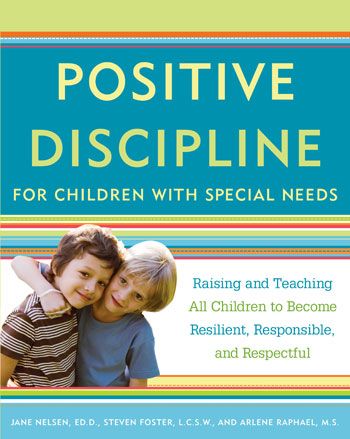
Positive Discipline for Children with Special Needs
I provide training for staff in a variety of child care settings: residential, foster, day care, etc. & I provide family life coaching services. At resource information fairs for families, I recommend this book. I frequently reference this book in my training events. The authors do a fantastic job of presenting the positive discipline tools through case studies. I highly recommend this book if you work or live with special needs children & or trauma exposed children.